
September 7, 2026
Market Intelligence

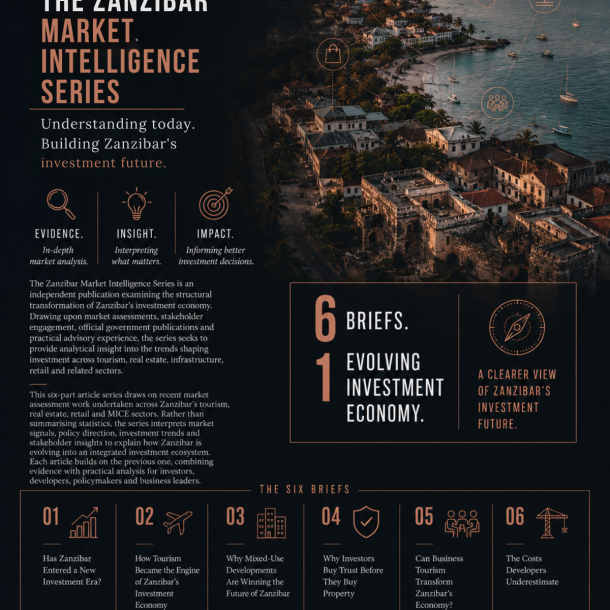
The Zanzibar Market Intelligence Series
Published by Inner-Works Consultants
Market Intelligence Brief No. 1
Zanzibar is no longer simply experiencing tourism growth; it is undergoing an economic transformation in which tourism increasingly drives investment across real estate, hospitality, retail, infrastructure and professional services. This brief argues that the islands are entering a new investment era characterized by sector convergence, rising investor sophistication and a transition from volume-driven tourism towards higher-value, integrated development.
For much of the last three decades, Zanzibar has been viewed primarily through the lens of tourism. Its global identity has been shaped by pristine beaches, the cultural heritage of Stone Town, the spice trade, and the allure of an Indian Ocean island destination. Tourism has undoubtedly become the backbone of the economy, generating employment, foreign exchange earnings and investment opportunities. Yet to define Zanzibar today simply as a tourism destination is to overlook a far more profound transformation taking place beneath the surface.
Recent years have witnessed an acceleration in investment activity across multiple sectors, accompanied by major policy reforms, expanding infrastructure, changing investor profiles and evolving consumer preferences. Visitor arrivals continue to reach record levels, but the significance of this growth extends well beyond hotels and holiday packages. Tourism has become the catalyst for a broader economic transformation, influencing where capital flows, how developments are conceived, what products are brought to market and even how institutions are adapting to regulate an increasingly sophisticated investment landscape.
Official tourism statistics illustrate the scale of this transformation. International visitor arrivals increased from approximately 260,000 in 2020 to more than 917,000 in 2025, representing sustained growth over a relatively short period. At the same time, visitors are staying longer, spending more, and increasingly seeking experiences that extend beyond the traditional “sun, sand and sea” offering. These trends have encouraged investors to pursue new opportunities in hospitality, residential development, retail, lifestyle destinations and supporting services rather than focusing exclusively on conventional hotel developments.
This evolution is also reflected in government policy. Recent strategic direction points towards a deliberate transition from volume-driven tourism to higher-value, experience-led development. Diversification into culture, wellness, sports tourism, marine tourism and business events has become increasingly prominent within Zanzibar’s development agenda. Rather than simply attracting more visitors, the emphasis is gradually shifting towards attracting the right visitors—those who stay longer, spend more, invest more deeply and contribute to wider economic participation.
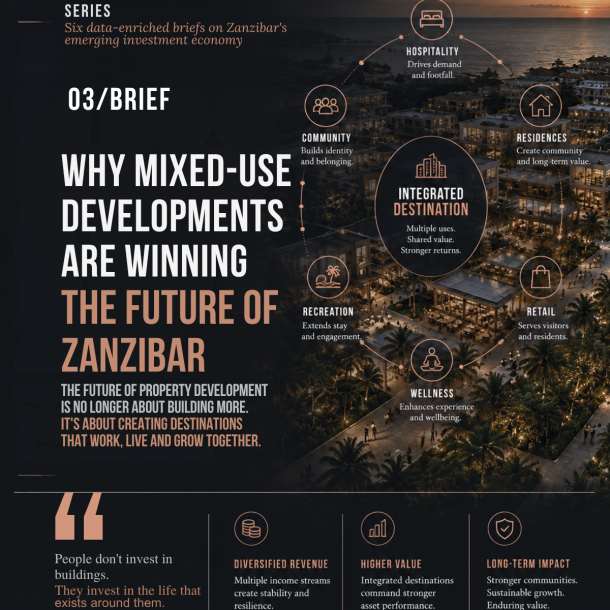
Perhaps the clearest evidence of this transition can be seen in the investment pipeline itself. Tourism developments are no longer limited to hotel construction. Increasingly, projects combine hospitality, residential property, retail, wellness facilities, food and beverage offerings, recreational amenities and commercial space within integrated master-planned developments. This convergence reflects a growing recognition that modern investment returns are generated not merely by accommodation, but by creating destinations that people can live in, invest in, work from and experience throughout the year.
The implications extend far beyond tourism. Rising visitor numbers stimulate demand for serviced apartments, branded residences, retail centres, restaurants, logistics providers, legal services, financial institutions, construction firms and digital infrastructure. Developers are responding by creating increasingly complex investment products. Government institutions are adapting regulatory frameworks to accommodate these changes, while investors are placing greater emphasis on governance, legal certainty, infrastructure and long-term operational sustainability than ever before.
This article argues that Zanzibar is entering a new investment era. The defining characteristic of this new phase is not simply stronger economic performance, but the emergence of an interconnected investment ecosystem in which tourism, real estate, infrastructure, retail, hospitality and professional services reinforce one another. Understanding this shift is essential for anyone seeking to invest, develop or formulate policy within Zanzibar over the coming decade.
The purpose of this first Market Intelligence Brief is therefore not merely to review economic indicators, but to examine what those indicators collectively reveal about the changing nature of Zanzibar’s economy. It seeks to answer a fundamental question: Has Zanzibar moved beyond being a successful tourism destination to becoming one of East Africa’s emerging integrated investment ecosystems?
The evidence presented throughout this series suggests that the answer is increasingly yes.
Markets rarely transform overnight. More often, they evolve gradually through a series of interconnected changes that, when viewed in isolation, appear incremental but, when considered collectively, signal the emergence of an entirely new phase of development. Zanzibar appears to have reached precisely such a moment.
It would be easy to conclude that the island’s recent success is simply the result of increasing tourist arrivals. Indeed, official statistics present an impressive trajectory. International visitor arrivals have grown consistently from approximately 260,644 visitors in 2020 to 917,167 visitors in 2025, representing an average annual growth rate exceeding 25 percent. Visitor stays have lengthened to an average of approximately eight nights, while bed occupancy has remained healthy, reflecting sustained demand for accommodation across the destination.
Viewed independently, these figures suggest a thriving tourism industry. Yet focusing exclusively on visitor numbers risks overlooking the more important story unfolding beneath them.
The defining characteristic of mature investment destinations is not simply that more people arrive; rather, it is that visitor demand begins to reshape the wider economy. In Zanzibar, tourism is no longer functioning as an isolated sector. Instead, it is increasingly influencing patterns of investment, urban development, infrastructure planning, professional services, retail expansion and even institutional reform. The market is becoming interconnected.
This distinction is important because economic transformation is rarely measured by growth alone. It is measured by the relationships that develop between industries.
Historically, tourism in Zanzibar generated demand primarily for hotels, restaurants and excursion operators. Today, however, the investment response is markedly different. Developers are delivering branded residences, serviced apartments, mixed-use communities, lifestyle destinations and integrated hospitality concepts. Retail operators are beginning to respond to a growing market of higher-spending visitors and expatriates. Professional services—including legal advisory, finance, architecture, engineering and property management—are assuming increasingly strategic roles within development projects. Each sector is no longer responding independently to tourism; instead, they are reinforcing one another within a broader investment ecosystem.
Government policy appears to recognise this evolution. The ongoing Tourism Transformation agenda reflects a deliberate shift away from measuring success purely through visitor volumes towards attracting higher-value tourism capable of generating stronger economic linkages. Greater emphasis is now placed on cultural tourism, wellness, sports tourism, marine experiences and business events, alongside improving governance, sustainability and destination competitiveness. The objective is no longer simply to welcome more tourists, but to encourage longer stays, greater expenditure and deeper integration with the domestic economy.
The investment pipeline reinforces this narrative. Between 2020 and mid-2025, approved investment across accommodation and food services exceeded US$1.9 billion, while real estate attracted more than US$730 million in proposed investment. More significantly, the composition of these projects reveals a market moving towards higher-value products, including luxury resorts, villa developments, branded residences, wellness destinations and hybrid hospitality-real estate models. These are not merely larger projects; they are structurally different projects, designed to generate value through multiple revenue streams rather than accommodation alone.
The Zanzibar Investment Promotion Authority’s own reporting similarly points towards increasing investor confidence. Over recent years, hundreds of projects representing billions of dollars in proposed capital have been registered across tourism, manufacturing, real estate and related sectors, reflecting an increasingly diversified investment landscape. While not every approved project will ultimately be implemented, the scale of registered investment demonstrates growing confidence in Zanzibar’s long-term economic trajectory.
Yet statistics alone remain imperfect indicators of market maturity.
One of the recurring observations arising from this market assessment is that the most meaningful changes occurring within Zanzibar are qualitative rather than purely quantitative. Investors are becoming more sophisticated. Buyers are asking different questions. Developers are reconsidering project design. Government institutions are reviewing policy frameworks. International brands are evaluating opportunities that would have been considered premature only a decade ago. None of these developments can be adequately captured through arrival figures or capital investment statistics alone.
Perhaps the clearest signal of market maturity is the increasing convergence of sectors that historically operated independently. Tourism now influences residential property markets. Residential developments increasingly incorporate hospitality services. Hospitality projects include retail, wellness and commercial space. Retail performance depends not only on local purchasing power but also on visitor expenditure and expatriate populations. Conferences and business events create demand extending far beyond meeting venues, stimulating accommodation, transport, food and beverage, entertainment and local supply chains. In other words, each component of the economy is becoming progressively more dependent upon the performance of the others.
This interconnectedness changes how investment opportunities should be evaluated. Projects can no longer be assessed solely on the strength of one asset class or one revenue stream. Their long-term success increasingly depends upon how effectively they integrate with the wider destination economy.
This observation introduces what may be the defining characteristic of Zanzibar’s next phase of development: investment convergence.
Rather than viewing tourism, real estate, hospitality and retail as separate sectors, investors are increasingly recognising them as complementary components of a single economic system. The competitive advantage of future developments will therefore depend less on the quality of individual buildings and more on the quality of the ecosystem they create.
If this interpretation is correct, then Zanzibar has already begun moving beyond the traditional model of tourism-led growth. It is entering a phase in which investment is driven not by individual sectors in isolation, but by the relationships between them. Understanding those relationships is likely to prove far more valuable than simply tracking visitor numbers.
The next section explores this transformation in greater depth by examining how Zanzibar is evolving from a successful tourism destination into an integrated investment ecosystem, and why this shift may fundamentally redefine how investors, developers and policymakers approach the islands over the coming decade.
If the first phase of Zanzibar’s economic story was defined by tourism, the next phase is likely to be defined by something considerably more sophisticated: the emergence of an integrated investment ecosystem.
For many years, tourism represented a distinct economic sector. Hotels welcomed visitors, restaurants served meals, tour operators organised excursions, and airlines transported travellers to the islands. Although these activities generated employment and foreign exchange, they largely functioned within their own commercial boundaries. Success was measured primarily by visitor arrivals, hotel occupancy and tourism receipts.
Today, that distinction is becoming increasingly blurred.
Tourism no longer operates as an isolated industry. It has become the principal catalyst influencing investment decisions across sectors that, at first glance, appear only loosely connected to visitor activity. Residential property, commercial real estate, retail, infrastructure, professional services, healthcare, education and financial services are all beginning to respond to demand initially created by the growth of the tourism economy. What emerges is not merely a larger tourism sector, but an increasingly interconnected economic system.
One of the clearest examples of this transformation is visible within Zanzibar’s real estate market.
A decade ago, tourism development was largely synonymous with hotel construction. Investors sought beachfront land, developed accommodation facilities and generated returns through room occupancy. While this model continues to exist, it no longer defines the market.
Recent investment patterns indicate a decisive shift towards integrated developments combining hospitality with residential ownership, branded residences, serviced apartments, wellness facilities, food and beverage offerings, retail space and recreational amenities. Rather than asking how many hotel rooms a site can accommodate, developers are increasingly asking how multiple uses can coexist to create stronger financial performance and a more resilient investment proposition. This evolution reflects changing consumer preferences as much as changing investment strategies.
The market assessment undertaken for this series consistently pointed towards the same conclusion. Projects that differentiate themselves through integrated experiences, lifestyle positioning and operational flexibility are increasingly outperforming developments competing primarily on accommodation alone. Boutique hotels, villa concepts, branded residences and experience-led hospitality products are demonstrating stronger market appeal than undifferentiated mid-market offerings competing largely on price.
Importantly, this shift is occurring alongside broader changes in visitor behaviour.
Official tourism statistics indicate that leisure visitors continue to dominate arrivals, with holidays accounting for the overwhelming majority of trips. However, the profile of these visitors is gradually evolving. Average lengths of stay have increased, repeat visitation remains significant and demand has expanded beyond traditional beach holidays towards cultural experiences, wellness, marine activities and increasingly personalised travel. These trends encourage investment in products capable of delivering a broader visitor experience rather than simply providing accommodation.
Government policy reflects this direction. The ongoing review of Zanzibar’s tourism strategy places increasing emphasis on diversification, sustainability and higher-value tourism experiences. Rather than relying predominantly on traditional beach tourism, policymakers are encouraging expansion into culture, heritage, wellness, sports tourism, marine experiences and business events. Such diversification broadens investment opportunities far beyond conventional hospitality assets and encourages stronger linkages with local enterprises and supporting industries.
This changing environment is also influencing the composition of the investor community itself.
Historically, many investors approached Zanzibar through relatively straightforward hospitality projects. Increasingly, however, developers are arriving with more sophisticated investment models incorporating condominium ownership, managed residences, rental pool structures, phased master-planned communities and mixed-use precincts capable of generating multiple income streams. These structures acknowledge an important market reality: investors are seeking flexibility. They wish to holiday, generate rental income, preserve capital and participate in long-term appreciation through a single investment vehicle.
The evolution of buyer behaviour reinforces this trend.
Market observations suggest that purchasers are no longer evaluating projects solely on location or projected financial returns. Increasing attention is being given to governance structures, legal certainty, operational management, developer credibility and the long-term sustainability of the community itself. The purchase decision has become multidimensional, requiring developers to compete on trust, execution capability and overall investment quality rather than architectural design alone. These themes will be explored in greater detail later in this series, but they already illustrate how significantly the market has matured.
The consequences extend well beyond the real estate sector.
As residential communities expand, demand follows for supermarkets, cafés, restaurants, healthcare services, schools, financial institutions, maintenance providers, transport operators, digital infrastructure and professional advisory services. A successful development therefore creates secondary economic activity that continues long after construction has been completed. Investment begins to generate investment.
This multiplier effect is perhaps one of the least appreciated characteristics of Zanzibar’s current transformation. While tourism remains the catalyst, its influence increasingly extends across almost every aspect of the economy. Each new hotel generates demand for local suppliers. Each residential development creates opportunities for retailers and service providers. Every conference or destination event stimulates expenditure across accommodation, transport, food and entertainment. As these interactions become more frequent, the economy develops greater resilience because growth is supported by multiple interconnected sectors rather than dependence upon a single industry.
Viewed collectively, these developments suggest that Zanzibar is beginning to exhibit many of the characteristics associated with emerging integrated investment destinations elsewhere in the world. Economic value is increasingly created not through isolated projects, but through ecosystems in which tourism, real estate, retail, infrastructure and professional services reinforce one another.
This does not imply that the transformation is complete. Challenges relating to infrastructure, regulatory coordination, execution capacity, environmental sustainability and skills development remain significant. Nevertheless, the direction of travel appears increasingly clear. Zanzibar is moving beyond an economy that simply benefits from tourism towards one in which tourism provides the foundation upon which broader investment activity is constructed.
Recognising this distinction is critical because it fundamentally changes how opportunities should be assessed. Investors who continue to evaluate projects solely through the lens of hotel performance or visitor arrivals may fail to appreciate the wider forces reshaping the market. Conversely, those who understand how these sectors are converging will be better positioned to identify opportunities that extend beyond traditional tourism assets.
If the emergence of an integrated investment ecosystem explains how Zanzibar is changing, the next question is perhaps even more important: what exactly are investors buying? Surprisingly, the answer has less to do with beachfront land or projected returns than many might assume. It begins with confidence, certainty and trust. That is where the next part of this analysis turns.
Markets rarely reward the product that sellers believe they are offering.
Developers often assume they are selling apartments, villas, hotel rooms or beachfront land. Yet conversations with investors, observations from ongoing developments and the broader findings emerging from this market assessment suggest that buyers are increasingly purchasing something far less tangible.
They are buying confidence.
This distinction may appear subtle, but it fundamentally changes how successful developments should be conceived, marketed and delivered.
In younger property markets, location often dominates purchasing decisions. As markets mature, however, buyers become progressively more sophisticated. They recognise that a prime location alone cannot compensate for weak governance, uncertain ownership structures, delayed construction or ineffective management. Consequently, investment decisions become less focused on physical assets and more focused on confidence in the ecosystem surrounding those assets.
This evolution is becoming increasingly evident in Zanzibar.
Throughout discussions with developers, advisers and market participants, one theme consistently emerged above all others: trust has become one of the market’s most valuable commodities.
Unlike mature real estate markets where extensive transaction histories, transparent pricing databases and established institutional frameworks provide confidence, Zanzibar remains an emerging market. Information is fragmented, transaction data is relatively limited and many buyers are investing from abroad with limited familiarity with local regulatory systems. Under such conditions, perceived risk inevitably becomes a significant component of every investment decision.
As risk increases, trust acquires measurable economic value.
This may be referred to as the Trust Premium.
The Trust Premium describes the additional value investors are willing to attribute to projects that demonstrate credibility through proven delivery, transparent legal structures, competent management and established operational performance.
In practical terms, two developments may occupy equally attractive beachfront locations and offer comparable architectural quality. Yet the project delivered by an experienced developer with completed projects, functioning infrastructure, professional property management and clearly documented ownership rights will frequently command stronger demand than a competing project relying solely upon attractive marketing materials or ambitious financial projections.
Market observations contained within the feasibility assessment strongly support this conclusion.
Buyer decisions are influenced by a combination of factors extending well beyond projected investment returns. Legal clarity, developer reputation, construction progress, rental management arrangements, payment flexibility and the visibility of completed communities all play increasingly important roles in determining purchasing behaviour. Completed or near-completed developments consistently inspire greater confidence than projects marketed purely from architectural renderings, reflecting growing caution towards off-plan investments following delivery delays experienced within various emerging markets.
This is perhaps one of the clearest indicators of market maturity.
Investors are no longer asking only, “What return can this property generate?”
They are increasingly asking:
“Will this project actually be delivered?”
“How secure is my ownership?”
“Can I resell to another foreign buyer?”
“Who manages the property once construction finishes?”
“Will the surrounding community continue developing?”
“Can I realistically rely on the projected rental income?”
These questions reveal an important shift in investor psychology. Returns remain important, but certainty increasingly determines whether those returns are considered achievable.
Legal structuring therefore becomes far more than a compliance exercise.
Within Zanzibar, condominium frameworks, ownership documentation, transferability, rental management agreements and governance arrangements increasingly form part of the product itself. Sophisticated buyers evaluate legal architecture with the same seriousness as physical architecture. Poorly structured ownership arrangements, unclear exit mechanisms or inconsistencies between marketing materials and contractual documentation can significantly reduce buyer confidence, regardless of location or design quality. Conversely, transparent legal structures become competitive advantages capable of accelerating market absorption and strengthening long-term asset value.
Trust also extends beyond legal documentation into the operational life of a development.
Projects that demonstrate active communities, functioning amenities, occupied residences and visible management communicate a level of certainty that architectural renderings alone cannot achieve. Buyers derive reassurance not only from the existence of completed buildings but from evidence that the wider ecosystem functions effectively. Occupied developments signal successful execution. They demonstrate that promises have translated into reality.
This observation helps explain why community has become an increasingly important investment consideration.
Historically, many developments competed on individual units. Increasingly, however, investors evaluate the broader environment in which those units exist. Restaurants, wellness facilities, retail offerings, walkability, security, recreational spaces, digital connectivity and social interaction collectively contribute towards perceived value. Investors are not merely purchasing square metres; they are investing in an experience capable of supporting both personal enjoyment and long-term asset performance.
The implications extend beyond individual developments.
As trust becomes an increasingly influential determinant of investment decisions, the competitive landscape itself begins to change. Developers able to establish reputations for transparency, delivery and professional management will progressively differentiate themselves from competitors relying primarily upon pricing or location. Over time, reputation evolves into a strategic asset capable of reducing marketing costs, accelerating sales and supporting premium pricing.
Perhaps most importantly, the emergence of the Trust Premium reflects a broader transformation occurring within Zanzibar’s investment market. Buyers are behaving less like speculative purchasers and more like long-term investors. They are evaluating governance alongside geography, execution alongside aesthetics and operational sustainability alongside projected returns.
That behavioural shift may ultimately prove one of the strongest indicators that Zanzibar is entering a new phase of market maturity.
This brief began by asking whether Zanzibar has entered a new investment era. The evidence suggests that it has.
The transformation, however, is not defined simply by rising visitor arrivals, increasing investment commitments or larger development projects. Rather, it reflects a more fundamental shift in the structure of the economy. Tourism is evolving beyond a standalone industry to become the foundation of a broader investment ecosystem, influencing real estate, hospitality, retail, infrastructure and an expanding range of professional services.
At the same time, investor priorities are changing. Increasingly, investment decisions are influenced not only by location and projected returns, but also by governance, legal certainty, execution capability and long-term operational sustainability. As markets mature, confidence becomes as valuable as capital, and trust becomes as important as opportunity.
Collectively, these developments point towards a market that is becoming more sophisticated, more interconnected and more competitive. Understanding this transition is essential for investors, developers and policymakers alike, as it fundamentally changes not only where opportunities exist, but also how they should be evaluated.
Ultimately, the story of Zanzibar is no longer about tourism alone. It is about what tourism has made possible.
Market Intelligence Brief No. 2 examines how tourism has quietly evolved beyond a standalone industry to become the principal economic engine influencing investment across Zanzibar’s wider economy. By exploring the economic linkages between tourism, real estate, retail, construction and professional services, the next brief demonstrates why understanding tourism today requires looking far beyond visitor arrivals.
Series navigation: View the Series | Next Brief