
September 8, 2026
Market Intelligence

The Zanzibar Market Intelligence Series
Published by Inner-Works Consultants
Market Intelligence Brief No. 2
How Tourism Quietly Became the Engine of Zanzibar’s Investment Economy
Tourism has long been recognised as Zanzibar’s leading economic sector. However, recent market developments suggest its role extends far beyond visitor arrivals, hotel occupancy and foreign exchange earnings. This Market Intelligence Brief argues that tourism has evolved into the principal economic engine shaping investment across Zanzibar’s wider economy. Its influence increasingly extends into real estate, retail, infrastructure, construction, financial services and professional advisory sectors, fundamentally changing how investment opportunities should be understood and evaluated.
Few industries possess the ability to reshape an economy beyond their immediate commercial boundaries. Tourism is one of them.
For decades, Zanzibar’s tourism industry has been measured using familiar indicators: visitor arrivals, hotel occupancy, average length of stay and tourism receipts. These remain valuable indicators of sector performance, but they no longer tell the complete story. The more significant question today is not how tourism itself is performing, but how its continued growth is influencing the broader economy.
This distinction is important because mature tourism destinations are rarely defined by hotels alone. Their competitiveness increasingly depends upon the extent to which tourism stimulates investment across multiple interconnected sectors. Hotels create demand for construction. Construction supports manufacturing and logistics. Residential developments emerge alongside hospitality projects. Retail follows expanding communities. Professional services become increasingly specialised. Infrastructure improves in response to growing economic activity. In time, tourism evolves from being one industry among many into the platform upon which much of the wider economy operates.
There is growing evidence that Zanzibar is entering precisely such a phase.
Official statistics illustrate the continued expansion of the tourism sector. International visitor arrivals exceeded 917,000 in 2025, representing sustained growth over recent years, while average visitor stays remained close to eight nights. These figures demonstrate a healthy tourism industry, but they reveal little about the increasingly complex network of economic relationships developing around it.
The purpose of this Market Intelligence Brief is therefore not to analyse tourism in isolation. Rather, it examines tourism as the economic catalyst influencing investment decisions across Zanzibar’s wider economy. It argues that understanding tourism today requires looking far beyond hotels and holidaymakers. Instead, it requires understanding how visitor demand increasingly shapes property markets, commercial development, infrastructure investment, retail expansion and professional services.
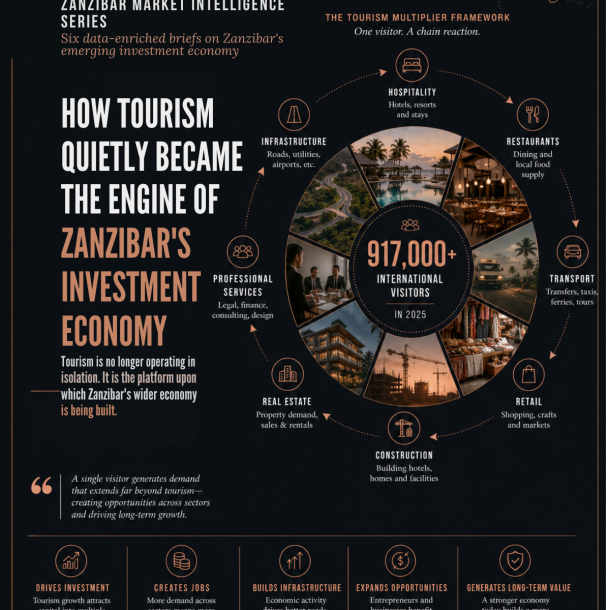
In doing so, this brief introduces the Tourism Multiplier Framework—a practical model illustrating how a single visitor generates economic activity far beyond the tourism sector itself.
The contribution of tourism to Zanzibar’s economy is often measured through a familiar set of indicators: visitor arrivals, hotel occupancy, average length of stay and tourism receipts. These metrics remain important because they provide an indication of the sector’s overall health and performance. Yet, on their own, they reveal very little about tourism’s true economic significance.
The real value of tourism lies not in the visitor, but in the chain of economic activity that each visitor sets in motion.
This distinction fundamentally changes how tourism should be understood. A visitor arriving at Abeid Amani Karume International Airport does not simply purchase a hotel room. That visitor becomes the starting point of a much broader economic cycle. Accommodation providers purchase food from local suppliers. Restaurants employ chefs, waiters and managers. Tour operators contract guides and drivers. Retail businesses respond to increased consumer spending. Developers identify opportunities for new hospitality and residential projects. Financial institutions finance investment. Lawyers, architects, engineers and consultants structure, design and facilitate those investments. Government collects revenue through taxes, fees and licences, allowing further investment in infrastructure and public services.
Viewed individually, these transactions may appear unrelated. Collectively, however, they demonstrate that tourism functions as the primary catalyst connecting numerous sectors of Zanzibar’s economy.
This relationship can be described through what this publication refers to as the Tourism Multiplier Framework.
Unlike the traditional perception of tourism as a self-contained industry, the Tourism Multiplier Framework recognises tourism as the first link in a chain of interconnected economic activity. Each visitor generates demand that extends progressively further from the original tourism product, creating opportunities across sectors that may never interact directly with tourists themselves.
At its simplest, the process begins when an international visitor chooses Zanzibar as a destination. That decision immediately creates demand for accommodation, transportation and food services. Yet the economic impact does not end there. Hotels require furniture, linen, construction materials, maintenance services, utilities, technology systems and professional management. Restaurants purchase agricultural products, seafood, beverages and cleaning supplies. Tour operators depend upon vehicle maintenance, fuel suppliers, insurance providers and digital booking platforms.
Every transaction creates another.
Every business supports another.
The multiplier effect continues long after the visitor has departed.
Official statistics illustrate the scale of this foundation. Zanzibar welcomed more than 917,000 international visitors during 2025, with approximately 99 percent travelling for holiday purposes. The average visitor remained on the islands for approximately eight nights, generating sustained demand for accommodation and associated services throughout their stay. Although these figures are often presented simply as tourism statistics, they also represent hundreds of thousands of individual economic transactions occurring across multiple industries every year.
Importantly, the multiplier effect extends beyond immediate visitor expenditure.
As tourism demand increases, investors begin responding not only to current visitor numbers but also to expectations of future growth. Hotel development stimulates surrounding infrastructure. Residential projects emerge to accommodate employees, expatriates and lifestyle investors. Retail centres expand to serve both residents and visitors. Improved roads, airports and utilities increase accessibility, encouraging further private investment. Tourism therefore generates both direct expenditure and long-term capital formation.
Recent investment patterns observed across Zanzibar demonstrate precisely this relationship.
The continued expansion of tourism has been accompanied by significant investment in hospitality, real estate and mixed-use developments. Increasingly, investors are pursuing projects that combine accommodation, residential ownership, retail, wellness facilities and commercial space within integrated master-planned communities. These developments are responding not only to existing tourism demand but also to confidence in the sector’s long-term capacity to support broader economic growth.
The composition of visitor demand further reinforces this evolution.
European travellers continue to account for approximately two-thirds of international arrivals, while several emerging source markets have recorded notable growth in recent years. These visitors increasingly seek experiences extending beyond traditional beach holidays, creating opportunities for cultural tourism, marine activities, wellness, gastronomy and premium lifestyle offerings. Such diversification expands the range of businesses capable of participating in the tourism economy and reduces dependence upon a narrow hospitality model.
Perhaps the most significant implication of the Tourism Multiplier Framework is that it changes how economic success should be measured.
A successful tourism sector should not be judged solely by the number of visitors arriving each year. Rather, it should be evaluated by the extent to which visitor expenditure circulates throughout the domestic economy, creates employment, stimulates entrepreneurship, attracts investment and strengthens local supply chains.
From this perspective, the objective is not simply to increase tourism.
The objective is to maximise tourism’s ability to generate wider economic value.
This distinction aligns closely with Zanzibar’s broader policy direction. Government strategies increasingly emphasise higher-value tourism, diversification, sustainability and stronger economic linkages rather than visitor growth alone. The emphasis is gradually shifting from quantity towards quality—from attracting more tourists to creating greater value from each visitor who arrives.
Understanding tourism through this broader lens reveals why it has become far more than Zanzibar’s largest industry. It has become the economic platform upon which much of the island’s current and future investment activity depends.
The question that naturally follows is how this expanding economic influence is reshaping investment itself. Why are investors increasingly choosing mixed-use developments over standalone hotels? Why are branded residences, serviced apartments and integrated communities becoming more common? And why is tourism now influencing sectors that traditionally operated independently?
It is to these changing investment dynamics that the next section now turns.
The Tourism Multiplier Framework demonstrates that tourism creates far more than visitor expenditure. Yet its greatest influence may lie elsewhere. Tourism does not merely generate economic activity; it increasingly directs where investment capital flows.
This distinction is significant because investment decisions are inherently forward-looking. Investors rarely commit capital based solely on current demand. Rather, they invest where they believe future demand will exist. Tourism therefore performs a dual role within Zanzibar’s economy. It generates immediate economic activity through visitor expenditure while simultaneously shaping expectations about future growth. Those expectations, in turn, influence investment across multiple sectors.
The relationship between tourism and real estate provides perhaps the clearest illustration of this dynamic.
As visitor numbers have grown and the destination has gained greater international recognition, developers have responded with projects that extend well beyond traditional hotel accommodation. Increasingly, investment is being directed towards serviced apartments, branded residences, lifestyle communities, mixed-use developments and managed residential products capable of serving both tourism and long-term investment demand. These developments recognise an important market reality: visitors often become investors, and investors frequently begin as visitors.
This progression is not unique to Zanzibar, but it is becoming increasingly evident within the islands.
A traveller who enjoys repeated holidays may eventually purchase a holiday residence. A second-home owner may subsequently invest in additional units for rental income. Institutional investors observing these trends identify opportunities to finance larger integrated developments. Banks expand lending. Professional services become more specialised. Government responds by strengthening planning frameworks and investment facilitation. The original tourism transaction therefore evolves into long-term capital investment.
The market assessment undertaken for this series consistently highlighted this evolution. Investors are increasingly evaluating projects not solely on hospitality performance, but on their ability to generate multiple sources of value through residential ownership, recurring rental income, retail activity, food and beverage offerings, wellness facilities and destination experiences. Tourism is no longer viewed as the end product; it has become the foundation upon which broader investment models are being constructed.
The influence of tourism extends equally into sectors that, at first glance, appear disconnected from visitor activity.
Retail offers an important example.
Traditional thinking assumes retail demand is driven primarily by resident populations. While this remains true in many markets, Zanzibar’s tourism economy introduces an additional layer of demand. International visitors purchase local crafts, clothing, jewellery, food products, cosmetics and convenience goods. Higher-income expatriates and foreign property owners create year-round demand for premium supermarkets, restaurants, cafés and lifestyle retail. As integrated developments expand, retail increasingly becomes an essential component of destination planning rather than an afterthought.
Professional services have experienced a similar transformation.
The growing sophistication of investment projects has expanded demand for legal advisors, architects, engineers, surveyors, environmental consultants, financial institutions, insurers, project managers and technology providers. Large-scale developments require increasingly specialised expertise throughout their lifecycle—from feasibility and acquisition to financing, regulatory approvals, construction, operation and eventual resale. Tourism therefore supports an ecosystem of knowledge-based industries whose economic contribution extends well beyond the visitor economy itself.
Infrastructure investment further reinforces this relationship.
Public investment in airports, roads, utilities and digital connectivity has improved Zanzibar’s attractiveness as an investment destination, while private investment has responded by developing increasingly ambitious projects. This interaction creates a reinforcing cycle in which improved infrastructure supports tourism growth, tourism stimulates private investment and private investment strengthens the economic case for continued infrastructure development. Each element reinforces the others.
This cycle represents one of the defining characteristics of an emerging investment economy.
Importantly, the benefits of tourism are not measured solely by the volume of economic activity generated today, but by its capacity to influence tomorrow’s investment decisions. Every successful tourism season strengthens investor confidence. Every completed development reduces market uncertainty. Every improvement in infrastructure increases destination competitiveness. Over time, these incremental gains accumulate into a self-reinforcing investment ecosystem capable of sustaining broader economic transformation.
For policymakers, the implications are equally significant.
The objective should not simply be to maximise visitor arrivals. Rather, policy should seek to maximise tourism’s capacity to stimulate investment across complementary sectors, strengthen domestic supply chains and encourage higher-value economic activity. Success should therefore be measured not only by tourism’s direct contribution to GDP, but by its ability to catalyse investment throughout the wider economy.
Viewed through this broader lens, tourism ceases to be merely one sector among many.
It becomes the economic engine influencing the direction, scale and character of investment itself.
This brief set out to examine tourism not as an isolated industry, but as the principal economic force shaping Zanzibar’s wider investment landscape. The evidence suggests that this transformation is already well underway.
While visitor arrivals, occupancy rates and tourism receipts remain important indicators, they reveal only part of the story. Tourism’s greatest contribution lies in its ability to stimulate investment across real estate, retail, construction, infrastructure, financial services and a growing range of professional industries. Each visitor initiates a chain of economic activity that extends well beyond the tourism sector itself, while sustained growth continues to influence where both public and private capital are invested.
Understanding tourism through this broader perspective changes how opportunities should be assessed. The question is no longer whether tourism benefits the economy, but how effectively its growth can generate long-term value across the wider investment ecosystem.
As Zanzibar continues its transition towards a more diversified and sophisticated economy, tourism will increasingly be measured not only by the number of visitors it attracts, but by the quality of investment it inspires.
Tourism has evolved beyond a standalone industry to become the principal catalyst for wider economic activity.
Visitor expenditure creates multiplier effects across construction, retail, infrastructure, professional services and investment.
Tourism increasingly influences where investment capital is allocated, particularly within real estate and mixed-use developments.
Long-term economic success depends on strengthening linkages between tourism and complementary sectors rather than focusing solely on visitor growth.
Understanding tourism as an economic platform provides a more complete framework for evaluating Zanzibar’s future investment opportunities.
Market Intelligence Brief No. 3 explores one of the clearest manifestations of this transformation: the rise of mixed-use developments. As tourism, residential living, retail, hospitality and lifestyle experiences become increasingly interconnected, developers are moving beyond traditional hotel models towards integrated destinations capable of generating multiple revenue streams and creating long-term communities. The next brief examines why this shift is redefining the future of property development in Zanzibar.
Series navigation: Previous Brief | View the Series | Next Brief