
September 9, 2026
Market Intelligence

The Zanzibar Market Intelligence Series
Published by Inner-Works Consultants
Market Intelligence Brief No. 3
Mixed-use developments are increasingly redefining Zanzibar’s real estate landscape. As tourism matures and investor expectations evolve, developments that integrate hospitality, residential ownership, retail, wellness, recreation and commercial activity are proving more resilient than traditional single-purpose projects. This Market Intelligence Brief argues that the future of property development in Zanzibar will be determined not by the construction of individual buildings, but by the creation of integrated destinations capable of generating long-term economic, social and investment value.
For many years, successful tourism development in Zanzibar followed a relatively straightforward formula. Identify an attractive beachfront location, construct a hotel, provide food and beverage facilities, organise excursions and compete for international visitors. This model contributed significantly to the islands’ tourism growth and remains an important component of the hospitality sector today.
Yet the market that once rewarded this approach is changing.
Visitors are travelling differently. Investors are investing differently. Developers are increasingly designing projects around experiences rather than accommodation, while buyers are looking beyond individual properties towards the communities in which those properties exist. As these changes converge, the traditional distinction between hospitality, residential development, retail and recreation is becoming increasingly difficult to sustain.
This evolution is not unique to Zanzibar. Across many emerging tourism destinations, mixed-use developments have become the preferred model for creating long-term value. Rather than relying upon a single revenue source, these projects combine multiple complementary uses within one integrated environment. Hotels sit alongside branded residences. Retail and restaurants support both visitors and residents. Wellness centres, marinas, cultural attractions and recreational facilities extend visitor stays while creating amenities for permanent communities. Commercial activity continues throughout the year, reducing dependence upon seasonal tourism alone.
Zanzibar is beginning to exhibit many of these same characteristics.
Recent investment activity increasingly reflects a shift away from standalone hospitality projects towards developments capable of serving multiple markets simultaneously. Investors are no longer asking only whether a hotel can achieve strong occupancy rates. They are asking whether an integrated destination can generate residential sales, recurring rental income, retail activity, destination experiences and long-term asset appreciation within a single development.
This represents more than a change in project design.
It reflects a fundamental shift in how value is created.
Historically, a development’s success was measured by the performance of its primary asset. A hotel succeeded through occupancy. A residential project succeeded through sales. A shopping centre succeeded through foot traffic.
Mixed-use developments challenge this traditional approach.
Instead of relying upon one asset class, they generate value through the interaction between several complementary components. A hotel supports retail. Retail enhances residential demand. Residential communities sustain restaurants throughout the year. Wellness facilities attract additional visitors. Commercial space creates daytime activity. Events strengthen destination identity. Each component increases the value of the others.
In other words, the development begins functioning as an ecosystem rather than a collection of buildings.
This distinction is becoming increasingly important within Zanzibar’s evolving investment landscape. As discussed in the previous Market Intelligence Brief, tourism has developed into the principal economic platform shaping investment decisions across the islands. Mixed-use developments represent perhaps the clearest physical manifestation of that transformation. They convert tourism demand into diversified economic activity capable of generating multiple revenue streams while supporting broader community development.
The purpose of this Market Intelligence Brief is therefore not simply to explain what mixed-use developments are. Rather, it examines why they are becoming the preferred investment model, what market forces are driving their growth, and what this shift means for developers, investors and policymakers seeking to participate in Zanzibar’s next phase of economic transformation.
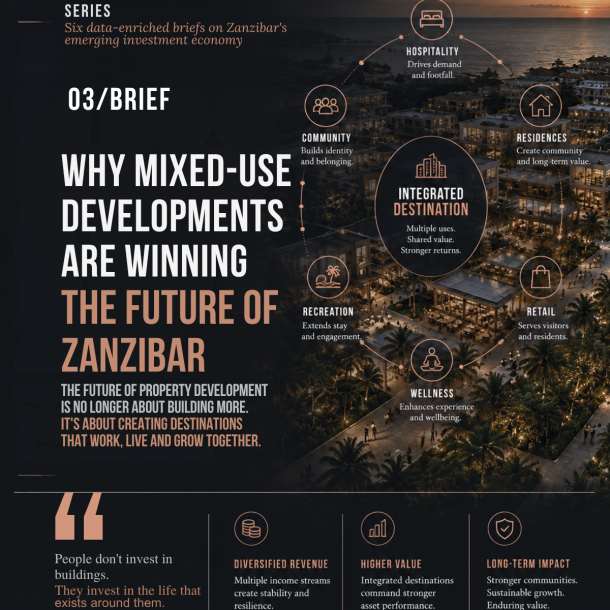
This brief introduces the Integrated Destination Framework, demonstrating how hospitality, residential ownership, retail, recreation and supporting services increasingly operate as one interconnected investment ecosystem rather than independent commercial activities.
Property markets evolve as consumer behaviour evolves. What buyers sought ten years ago rarely reflects what they seek today, and the projects that perform best are often those that recognise these shifts before the wider market does.
Zanzibar’s property market appears to be approaching such a moment.
Historically, tourism and real estate operated as largely separate industries. Hotels were designed to accommodate visitors for relatively short stays, while residential developments primarily served local communities or a limited number of private holiday homes. Retail developed independently around existing population centres, and commercial activity generally followed residential expansion.
Today, those distinctions are becoming increasingly blurred.
A visitor may arrive as a tourist, purchase a holiday residence, rent the property through a professionally managed programme when absent, spend extended periods working remotely, recommend the destination to family and friends, and eventually retire within the same community. What once represented several independent markets has gradually evolved into a single customer journey.
This evolution is influencing how successful developments are conceived.
Increasingly, the objective is no longer simply to construct buildings, but to create places capable of supporting multiple lifestyles and generating activity throughout the year. Hotels alone cannot achieve this objective. Nor can residential developments that become inactive outside holiday seasons. The market is increasingly rewarding projects capable of sustaining continuous economic and social activity through a balanced mix of complementary uses.
This represents an important departure from traditional development thinking.
Rather than asking, “What should be built on this site?” developers are increasingly asking, “How should this destination function?”
Although the difference may appear subtle, it fundamentally changes both project planning and investment strategy.
A destination functions as an ecosystem. Residents require supermarkets, cafés, healthcare facilities, recreational spaces, digital connectivity and reliable infrastructure. Visitors seek experiences, culture, convenience and hospitality. Investors require confidence that their assets will remain active, professionally managed and capable of generating long-term value. Businesses depend upon consistent customer activity rather than seasonal fluctuations. Mixed-use developments attempt to satisfy these different needs simultaneously, creating environments in which each component reinforces the others.
This evolution is particularly relevant within Zanzibar.
Unlike many mature urban property markets, much of Zanzibar’s large-scale development is occurring within previously undeveloped or underdeveloped coastal areas. Developers are therefore not simply constructing individual projects; they are shaping entirely new communities. Decisions concerning land use, infrastructure, public spaces, retail integration, mobility and environmental management will influence these destinations for decades.
Consequently, successful projects increasingly require a longer-term perspective than traditional real estate developments.
The market assessment undertaken for this publication consistently identified this trend. Across both completed and proposed developments, there is a growing recognition that purchasers are seeking more than physical property. Buyers increasingly evaluate the quality of the surrounding environment, the availability of services, the strength of property management, opportunities for rental income, community amenities and the overall lifestyle offered by the destination. The residential unit itself remains important, but it has become only one component of a broader investment proposition.
This shift also reflects wider global trends influencing tourism destinations.
International travellers are increasingly combining leisure with remote working, wellness, cultural experiences and longer seasonal stays. Improvements in digital connectivity have made location more flexible for many professionals, allowing destinations such as Zanzibar to compete not only for holidaymakers but also for lifestyle investors and location-independent workers seeking environments that combine quality of life with investment potential.
As these trends converge, developments designed around single uses may struggle to compete with projects capable of offering multiple experiences within one integrated environment.
Importantly, this does not suggest that every development should attempt to incorporate every possible land use.
Successful mixed-use developments are not defined by the number of components they include, but by the quality of integration between those components. A project combining hospitality, residential ownership, retail and wellness without a coherent operational strategy may perform no better than a traditional hotel. Integration must therefore extend beyond physical planning to encompass governance, management, infrastructure, programming and long-term destination stewardship.
This distinction is often overlooked.
Mixed-use development is not simply a planning concept.
It is an operational model.
Its long-term success depends not only upon construction quality, but also upon the ongoing interaction between residents, visitors, businesses, investors and the wider community.
For this reason, developers should perhaps view themselves less as builders of individual assets and more as curators of destinations.
That shift in mindset may prove to be one of the defining characteristics separating successful projects from those that merely add additional buildings to Zanzibar’s coastline.
If mixed-use developments represent the future of Zanzibar’s property market, an equally important question follows: what distinguishes a successful mixed-use development from one that simply combines different land uses?
The answer lies in integration.
There is a tendency within property markets to define mixed-use development by its physical components. Projects are often described according to the number of residential units, hotel rooms, retail outlets or commercial spaces they contain. While these metrics provide useful descriptions of scale, they reveal very little about the quality of the development itself.
Successful mixed-use developments are not defined by what they contain.
They are defined by how their components interact.
This publication refers to this relationship as the Integrated Destination Framework.
At its core, the framework recognises that each element within a development should strengthen the performance of the others. Hospitality creates demand for restaurants and retail. Retail enhances the attractiveness of residential ownership. Permanent residents support businesses during quieter tourism periods. Wellness and recreational facilities extend visitor stays while improving residents’ quality of life. Professionally managed public spaces encourage social interaction and strengthen destination identity. Together, these relationships create an environment in which the value of the whole exceeds the value of its individual components.
This shift has important implications for developers.
The traditional objective of maximising built area is gradually giving way to the objective of maximising long-term destination value. Public spaces become economic assets rather than unproductive land. Restaurants contribute not only to food and beverage revenue but also to residential demand. Landscape design, walkability, cultural programming and community events become commercial considerations because they influence how people experience, recommend and ultimately invest in a destination.
Viewed in this way, mixed-use development is no longer simply a property strategy.
It becomes a place-making strategy.
The market assessment undertaken during this study consistently pointed towards the importance of this distinction. Buyers repeatedly demonstrated greater interest in projects capable of offering an integrated lifestyle rather than isolated property ownership. The attractiveness of a residence was increasingly influenced by the surrounding amenities, the quality of management, the availability of experiences and the sense of community created within the wider development.
This observation reflects an important evolution in buyer behaviour.
People rarely purchase property solely because of the building itself.
They purchase the life they expect to live around it.
For holiday home buyers, that lifestyle may involve beachfront dining, wellness facilities, water sports and professionally managed rental programmes.
For long-term residents, it may involve reliable infrastructure, retail convenience, security, healthcare, education and social interaction.
For investors, it may involve occupancy, operational efficiency, governance and capital appreciation.
The most successful developments recognise that these objectives are not competing priorities. They are complementary outcomes produced by a well-integrated destination.
This also explains why operational management has become increasingly important within modern developments.
Unlike traditional residential projects, integrated destinations continue evolving long after construction has been completed. Public spaces require activation. Events require organisation. Landscapes require maintenance. Hospitality standards must be preserved. Property management must maintain confidence among owners while ensuring consistent visitor experiences. In many respects, the operational phase becomes just as important as the development phase itself.
Perhaps the greatest lesson emerging from Zanzibar’s evolving market is that successful developments are no longer measured by what is sold upon completion, but by how effectively they continue performing years afterwards.
That shift represents one of the clearest indicators that Zanzibar’s property market is entering a more mature stage of development.
This brief examined the growing role of mixed-use developments within Zanzibar’s evolving property market. The evidence suggests that their emergence reflects more than a change in architectural design or land use planning. Rather, it signals a broader transformation in how long-term investment value is being created.
As tourism matures and investor expectations become increasingly sophisticated, developments are moving beyond single-purpose projects towards integrated destinations capable of serving residents, visitors, businesses and investors simultaneously. Hospitality, residential ownership, retail, wellness and public spaces are no longer operating independently but are increasingly reinforcing one another within a shared economic ecosystem.
This evolution requires developers to think beyond construction and towards destination creation. Long-term success will depend not only upon the quality of individual buildings, but upon the quality of the communities, experiences and operational models that support them.
Ultimately, the future of Zanzibar’s property market may not belong to those who build the most impressive projects, but to those who create the most enduring places.
Mixed-use developments represent a fundamental shift in how long-term value is created within Zanzibar’s property market.
Successful projects function as integrated destinations rather than collections of independent buildings.
Buyer decisions are increasingly influenced by lifestyle, community, governance and operational quality alongside physical property.
Integration between hospitality, residential ownership, retail and public amenities creates stronger long-term economic resilience.
As Zanzibar’s market matures, destination creation is becoming as important as property development itself.
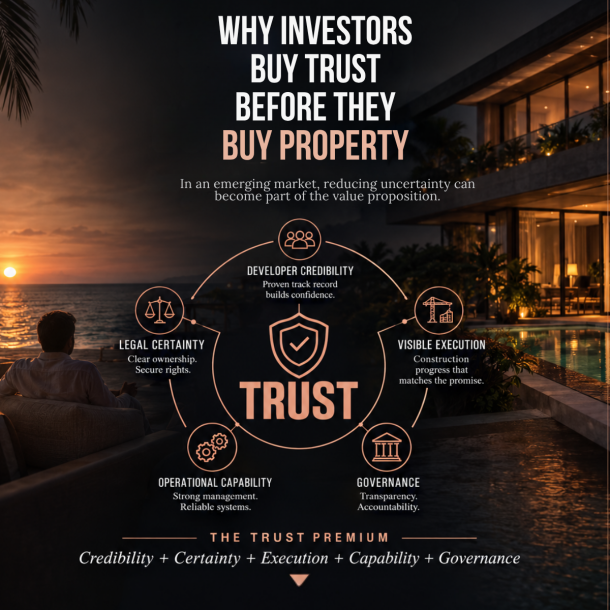
Market Intelligence Brief No. 4 examines another defining characteristic of Zanzibar’s evolving investment landscape: trust. As international investment increases and projects become more sophisticated, competitive advantage is shifting beyond location and design towards governance, legal certainty, transparency and execution capability. The next brief explores why, in emerging markets, investors often buy confidence before they buy property.
Market Intelligence Brief Number Three-Why Mixed-Use Developments Are Winning the Future of Zanzibar.
Series navigation: Previous Brief | View the Series | Next Brief