
September 12, 2026
Market Intelligence

The Zanzibar Market Intelligence Series
Published by Inner-Works Consultants
Market INTELLIGENCE Brief NO. 6
Development feasibility is often framed around three visible inputs: the cost of land, the estimated construction budget and the expected sales or operating revenue.
In Zanzibar, those figures rarely tell the whole story.
Projects must also absorb the cost of logistics, infrastructure extensions, utility resilience, imported expertise, design revisions, regulatory coordination, construction delays, coastal maintenance and operational readiness. The market assessment suggests that conventional feasibility models can underestimate total delivered cost by approximately 15–30%, while infrastructure requirements alone may add a further 10–20% depending on location and project scale.
This brief argues that the most important development cost is often not the price paid to acquire the site. It is the cumulative cost of converting that site into a functioning, compliant and commercially sustainable destination.
The projects most likely to succeed will therefore be those that budget for reality rather than merely designing for ambition.
Land is one of the easiest costs in a development to identify.
It has a price.
It can be negotiated.
It can be documented in a sale agreement or lease.
It appears neatly within a financial model.
Execution is far less cooperative.
Its costs emerge gradually through design changes, infrastructure requirements, regulatory conditions, logistics delays, contractor limitations, utility gaps and operational decisions that were not fully considered when the project was first conceived.
Individually, these costs may appear manageable.
Collectively, they can reshape the economics of an entire development.
This is particularly important in Zanzibar, where many development opportunities exist in coastal or emerging locations that may offer strong tourism appeal but limited supporting infrastructure. An attractive site can therefore create two very different impressions.
To the investor, it may appear to offer location, exclusivity and development potential.
To the project team, it may also represent roads, water systems, power generation, drainage, storage, waste management, logistics and continuous maintenance.
The difference between those two perspectives is what this brief describes as the Execution Gap.
The Execution Gap is the distance between the project as initially modelled and the project as it must actually be delivered.
Most feasibility failures do not begin with an obviously bad idea.
They begin with a good idea supported by incomplete assumptions.
A developer may have correctly identified demand for branded residences, a boutique resort or a mixed-use community. The market may exist. The land may be well located. The concept may be visually compelling.
But if the project cost excludes the full price of infrastructure, delays, compliance, operations and delivery risk, the feasibility model is not assessing the project.
It is assessing an idealised version of it.
The purpose of this final Market Intelligence Brief is therefore to examine the costs that frequently remain outside the headline budget and explain why execution discipline may ultimately matter more than land acquisition or conceptual ambition.
Construction budgets are often presented as though they represent the cost of development.
They do not.
They represent one component of the cost of development.
The market assessment distinguishes between budgeted cost and true delivered cost.
Budgeted cost generally includes the land interest, professional design, materials, labour and construction. True delivered cost includes those figures together with the friction created by operating within the actual development environment.
That friction may include:
importing materials and specialist equipment;
extending roads or upgrading site access;
redesigning elements that cannot be executed locally;
providing independent water and power systems;
carrying financing costs through delays;
replacing contractors or correcting defective work;
satisfying additional regulatory conditions;
and maintaining incomplete infrastructure during a phased development.
The assessment suggests that many feasibility models underestimate total project cost by approximately 15–30% because these elements are either excluded, understated or identified too late.
This distinction is important because cost overruns are rarely produced by one dramatic event.
They accumulate.
A revised foundation design increases professional fees.
A delayed shipment affects the construction programme.
The delay extends staff, consultant and financing costs.
Temporary power becomes necessary.
Late completion delays sales handover or hotel opening.
Cash receipts move further into the future while costs continue in the present.
By the time the individual effects are added together, the original return assumptions may no longer be realistic.
The true question is therefore not:
How much will the building cost?
It is:
How much will it cost to bring the entire project into operation?
That second question is far more demanding.
It requires developers to model development as a complete lifecycle rather than a construction exercise.
One of the most significant risks in Zanzibar development is the assumption that the surrounding environment will provide everything the project requires.
In many locations, it will not.
A project may need to provide or reinforce its own:
power generation and backup systems;
fuel storage;
water supply, treatment and storage;
wastewater and drainage systems;
access roads;
internet and communications infrastructure;
solid-waste systems;
staff transport;
security infrastructure;
and coastal or environmental protection measures.
The real-estate market assessment estimates that these infrastructure requirements can add approximately 10–20% to total project cost, while also affecting long-term operational efficiency.
This is not merely a capital-expenditure issue.
It is also an operating-cost issue.
A generator must be fuelled and maintained.
A borehole and water-treatment system require monitoring and replacement.
A privately maintained access road creates recurring obligations.
Salt air accelerates corrosion.
Coastal humidity affects finishes, equipment and maintenance cycles.
A development may therefore complete construction within budget and still underperform because its infrastructure model creates unsustainable operating costs.
This distinction matters particularly for projects sold on rental yields.
A buyer may be shown projected gross rental income, but the performance of the investment depends upon the costs deducted before distribution. Power, water, maintenance, management, replacement reserves and coastal wear can significantly affect net returns.
The broader real-estate assessment identifies high maintenance costs in coastal environments, seasonality and weak operational management among the risks that can undermine rental performance. It recommends realistic forecasts, stress-tested occupancy assumptions, clear disclosure of management charges and the use of experienced operators.
Infrastructure must therefore be treated as part of the commercial model.
It affects:
construction cost;
operational cost;
service quality;
investor confidence;
guest experience;
maintenance obligations;
and long-term asset value.
A development without reliable infrastructure is not simply inconvenient.
It is commercially weaker.
Some of Zanzibar’s most attractive projects are designed internationally.
That can bring valuable architectural experience, branding and technical sophistication.
It can also create a serious delivery risk.
A design created without sufficient understanding of local materials, contractor capability, climate, supply chains and construction methods may prove expensive or difficult to execute.
The market assessment identifies a recurring mismatch between internationally conceived designs and local delivery realities. This can produce redesign, rework, delays and cost overruns. Successful projects adapt their concepts early to local construction conditions rather than attempting to solve execution problems after construction begins.
This does not mean lowering quality.
It means designing intelligently for the environment in which the project will actually be built.
A locally adapted design should consider:
which materials can be sourced reliably;
which specialist items must be imported;
the lead times attached to those imports;
local contractor skill levels;
access for heavy equipment;
replacement and maintenance requirements;
exposure to salt, humidity and wind;
and whether the completed product can be operated locally at the expected standard.
A design may be technically possible and still be commercially impractical.
For example, a specialist façade system may produce a striking visual identity. But if replacement parts must be imported, installation expertise is scarce and the material performs poorly in a coastal environment, the design may increase long-term risk.
The strongest design is not always the most visually ambitious.
It is the design that balances identity, buildability, durability and operational practicality.
This leads to an important principle:
Local adaptation is not a compromise in design. It is part of good design.
Execution capacity is one of the most significant differences between a concept and a completed project.
The market assessment notes that Zanzibar has a limited pool of contractors able to deliver international-standard finishes at scale. Larger or more complex developments may therefore require imported expertise, hybrid contracting arrangements or stronger supervision than originally anticipated.
This affects cost in several ways.
International contractors or specialists may increase professional and mobilisation expenses.
Local contractors may require additional supervision, training or quality control.
Specialist subcontractors may be unavailable when required.
Poor coordination between contractors can delay dependent work.
Defective work may require removal and replacement.
Each of these creates what may be called the cost of rework.
Rework is particularly damaging because the developer effectively pays more than once:
first for the original work;
again for correction or replacement;
and indirectly through the time lost while the problem is resolved.
The cost may then continue through delayed sales, delayed opening, extended consultant appointments and additional financing charges.
Contractor selection should therefore not be based solely on the lowest quoted price.
A lower initial quotation may become the more expensive option if it does not reflect capacity, supervision, programme discipline, procurement planning and required quality.
Developers should assess:
the contractor’s delivery history;
current workload;
financial capacity;
access to skilled labour;
procurement systems;
quality-control procedures;
ability to work with international consultants;
and experience operating in Zanzibar’s logistical environment.
In development, the price of capability is usually visible.
The cost of incapability often appears later.
Regulatory approval is often treated as one milestone within a project timeline.
In practice, the process is more complex.
A development may involve business registration, investment approval, land structuring, planning requirements, environmental compliance, tourism licensing, construction approvals, inspections and operational permissions.
These processes may be sequential in some respects and parallel in others.
The supporting material describes a pathway involving institutions such as ZIPA, the Zanzibar Commission for Tourism, ZEMA, land authorities and local administrative structures. It also notes that timelines vary according to documentation quality, agency coordination and the completeness of the proposal.
The important point is that approval is not the same as readiness.
A concept may receive investment support while still requiring environmental conditions to be met.
A land structure may be agreed while planning matters remain outstanding.
A development may obtain construction-related approvals but still require operational licensing before opening.
The transition between each stage creates risk.
This brief therefore introduces a distinction between:
Regulatory Approval
and
Operational Readiness
Regulatory Approval confirms that a particular authority has accepted or authorised a defined component of the project.
Operational Readiness means the entire chain of land, design, compliance, infrastructure, construction, licensing and management is sufficiently aligned for the project to function.
Confusing the two can lead developers to announce timelines or begin commitments before critical dependencies have been resolved.
The supporting assessment identifies multi-agency overlap, incomplete submissions, environmental and land compliance, institutional coordination and changing project conditions as common sources of delay.
These delays have direct economic effects:
consultants remain engaged longer;
financing costs continue;
materials may increase in price;
sales timelines move;
contractors may seek extensions;
and project phasing may need to be revised.
Regulatory strategy should therefore be integrated into feasibility from the beginning.
It should not be treated as an administrative exercise to be addressed after the commercial concept has been finalised.
Large developments are rarely delivered in one uninterrupted construction programme.
They are phased.
Phasing can reduce capital exposure, allow market testing, demonstrate delivery and create revenue to support subsequent stages.
It can also weaken a project if the first phase is too small to function, if infrastructure is not properly allocated or if sales receipts are used without sufficient development controls.
The real-estate assessment identifies poor phasing, delays in infrastructure, weak contractor capacity and uncontrolled use of sales proceeds among the central delivery risks in Zanzibar’s off-plan market. Recommended mitigation includes linking payments to construction milestones, controlled or escrow-style mechanisms, transparent delivery reporting and independent verification.
A good phase should accomplish more than completing a group of buildings.
It should prove the model.
It should show that:
the developer can deliver;
infrastructure works;
public spaces can be maintained;
management systems operate;
buyers can occupy the units;
and the wider destination is beginning to function.
This is where the final original framework of the series becomes useful.
The Execution Pyramid
Land & Tenure
↓
Concept & Market Fit
↓
Legal and Regulatory Structure
↓
Infrastructure & Utilities
↓
Design & Procurement
↓
Construction & Quality Control
↓
Operations & Management
↓
Sales, Occupancy & Long-Term Returns
The pyramid is deliberately structured this way.
Returns sit at the top because they depend upon everything beneath them.
If the legal foundation is weak, the project becomes difficult to sell.
If infrastructure is unreliable, the asset becomes expensive to operate.
If design cannot be executed, construction delays.
If management is weak, rental performance falls.
If assumptions are unrealistic, sales absorption slows.
The return is therefore not created by the land.
It is created by the successful alignment of the entire pyramid.
Zanzibar’s visible development pipeline creates a strong impression of momentum.
That momentum is real.
But project announcements and registrations should not be confused with completed supply.
The market assessment estimates that only about 30% of the visible pipeline may be under active construction, with approximately 40% at an early or conceptual stage and a further 30% potentially facing delay or stalling. These figures are directional rather than a formal public census, but they capture an important distinction between investment intention and execution readiness.
This matters for several reasons.
First, investors should not assess competition based only on announced unit numbers.
Some projects may never reach the market.
Others may be delivered slowly or in substantially altered form.
Second, developers should not assume that a large pipeline means demand has already been absorbed.
Projects still compete on timing, credibility, price, product and completion.
Third, policymakers and market analysts should distinguish between:
registered projects;
approved projects;
financed projects;
projects under construction;
completed projects;
and operational projects.
Each category represents a different level of economic reality.
The same principle applies to projected capital figures.
Proposed investment demonstrates confidence and ambition.
Completed investment demonstrates execution.
Both matter, but they should not be treated as the same thing.
Feasibility models fail from both directions.
Costs may be understated.
Revenue may be overstated.
The assessment warns that developers sometimes benchmark Zanzibar against more mature or structurally different international markets without sufficiently accounting for seasonality, fragmented transaction data, buyer sensitivity and local absorption patterns. Overly optimistic pricing assumptions are identified as a major cause of underperformance.
This risk becomes particularly serious when high asking prices are used as evidence of market value.
The market assessment indicates that asking prices may sit approximately 15–35% above achieved transaction values, depending on location, legal clarity, developer credibility and product quality.
A feasibility model should therefore distinguish between:
marketed price;
reservation price;
contracted price;
completed-sale price;
and net cash actually received.
The same applies to rental income.
Projected gross yield is not the same as realised net return.
Occupancy, average daily rate, management fees, service charges, maintenance, utilities, refurbishment reserves and owner-use rights all influence the result.
The strongest models should include:
base-case assumptions;
downside scenarios;
slower sales absorption;
construction delays;
higher infrastructure cost;
lower achieved pricing;
and weaker-than-expected rental performance.
A feasibility model should not be designed to prove the project works.
It should be designed to identify the conditions under which it may stop working.
That is the difference between promotion and analysis.
This final brief began with the proposition that land may be one of the easiest development costs to understand.
The evidence supports that conclusion.
The true cost of development in Zanzibar emerges through the entire delivery chain: infrastructure, utilities, logistics, design adaptation, contractor capacity, approvals, phasing, operations and market absorption. These costs do not diminish the strength of the opportunity. They determine whether that opportunity can be converted into a functioning investment.
The market assessment suggests that project success depends less on the brilliance of the initial concept than on the alignment between concept, cost structure, execution capability and market reality. The strongest developments are locally adapted, realistically priced, legally clear and operationally sustainable.
For developers, this requires discipline before construction begins.
For investors, it requires due diligence extending beyond land and brochures.
For advisers, it requires integrating legal, financial, technical and operational thinking rather than treating them as separate workstreams.
And for policymakers, it requires recognising that the investment pipeline becomes economically meaningful only when projects move from approval to execution and from construction to operation.
Ultimately, projects rarely fail because the land was not attractive enough.
They fail because the full cost of making that land work was never properly understood.
Conventional feasibility models may underestimate total delivered project cost by approximately 15–30% when logistics, redesign, infrastructure and execution delays are not fully captured.
Infrastructure requirements—including power, water, storage and access—may add a further 10–20% to total cost and continue affecting operational performance after completion.
International design must be adapted to local construction capacity, materials, climate and maintenance realities.
Regulatory approval should not be confused with operational readiness; the process requires careful sequencing and active coordination across institutions.
Phasing should prove delivery, infrastructure and operations rather than merely divide construction into smaller portions.
Announced pipelines, asking prices and projected yields should be treated as market signals—not as completed evidence.
The Execution Pyramid demonstrates that long-term returns depend upon every layer beneath them, from tenure and legal structure to operations and market performance.
The six briefs in this series have examined Zanzibar’s emergence as an integrated investment economy from different but connected perspectives.
The first considered whether Zanzibar has entered a new investment era.
The second examined tourism as the economic engine shaping wider investment.
The third explored the rise of integrated destinations.
The fourth considered trust as an economic asset.
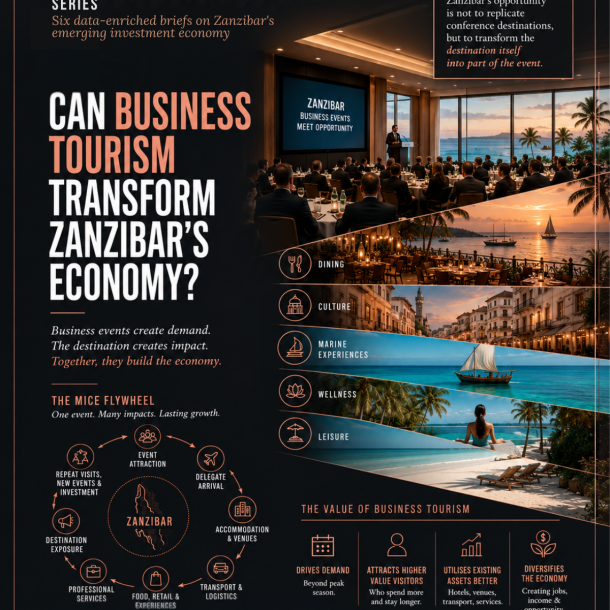
The fifth assessed the potential of business tourism and MICE.
This final brief has returned the discussion to execution.
Together, they point towards one central conclusion:
Zanzibar’s opportunity is substantial, but the next stage of growth will not be determined by opportunity alone.
It will be determined by the quality with which opportunity is structured, financed, regulated, delivered and managed.
Land creates possibility. Execution creates value.
Series navigation: Previous Brief | View the Series