
September 11, 2026
Market Intelligence

The Zanzibar Market Intelligence Series
Published by Inner-Works Consultants
Market INTELLIGENCE Brief NO. 5
Zanzibar’s tourism economy remains overwhelmingly leisure-led. Yet the emergence of conferences, corporate retreats, institutional meetings, incentive travel, destination events and other forms of business tourism presents an opportunity to address several structural weaknesses of the existing tourism model at once.
Business events can create demand outside traditional holiday periods, introduce different visitor profiles, increase utilisation of existing hospitality assets and generate expenditure across accommodation, transport, food and beverage, event production, professional services and retail. Zanzibar has already begun demonstrating its ability to attract regional and international events, but its MICE ecosystem remains constrained by venue capacity, logistics, technical infrastructure and limited specialist service providers.
This brief argues that Zanzibar should not seek to replicate established conference destinations. Its stronger opportunity lies in combining its existing tourism appeal with carefully targeted business events, retreats, incentives and destination experiences. In doing so, business tourism could become not simply another tourism segment, but an important instrument for increasing visitor value, reducing seasonality and diversifying the wider economy.
When most people think about tourism in Zanzibar, they picture beaches, resorts, Stone Town, marine excursions and holidaymakers.
They rarely picture board meetings.
That perception reflects the structure of the market itself. Zanzibar remains overwhelmingly a leisure destination, with the vast majority of international visitors travelling for holidays. Recent market analysis indicates that growth has remained substantially volume-driven, while diversification into higher-value visitor segments remains at an earlier stage.
Yet quietly, another market has begun developing.
Zanzibar has increasingly hosted regional and international conferences, investment forums, corporate gatherings, government meetings and major cultural and entertainment events. Recent examples identified during the market assessment include the TRACE Awards & Summit, AviaDev Africa Conference, the Zanzibar Investment Forum and a growing range of government, financial and tourism-sector conferences. Established cultural events such as Sauti za Busara further demonstrate the destination’s capacity to attract international audiences around programmed events rather than conventional holiday travel alone.
The significance of this development is easy to underestimate.
A conference delegate and a leisure tourist may occupy the same hotel room, travel through the same airport and dine at the same restaurant.
Economically, however, they represent different forms of demand.
The leisure visitor primarily chooses the destination.
The business traveller often travels because the event chose the destination.
That distinction matters because it gives destinations an additional mechanism for generating tourism demand. Instead of waiting for individual travellers to choose Zanzibar for a holiday, the destination can attract an organisation, company, institution or event that may bring tens, hundreds or potentially thousands of participants with it.
Business tourism can therefore create demand rather than simply respond to it.
This is particularly important for Zanzibar because one of the next challenges facing its tourism economy is not simply increasing visitor arrivals. It is improving the economic value generated from those arrivals, broadening the tourism product and creating stronger year-round demand.
MICE—Meetings, Incentives, Conferences and Exhibitions—provides one possible mechanism for achieving all three.
But there is an important qualification.
Zanzibar should not attempt to become Nairobi.
Nor should it attempt to become Mauritius overnight.
The market assessment shows that more mature regional and island destinations already possess deeper conference infrastructure, stronger institutional coordination and established business-tourism ecosystems. Zanzibar’s competitive advantage lies elsewhere: its island character, cultural identity, established leisure brand and ability to combine business with experience.
The opportunity, therefore, is not simply to build conference halls.
It is to transform the destination itself into part of the event.
The traditional distinction between business and leisure travel is becoming increasingly blurred.
A conventional conference destination competes primarily through venue capacity, accessibility, accommodation stock and technical infrastructure. These remain essential. But destination appeal has become increasingly important, particularly for corporate retreats, incentive programmes, executive meetings and regional conferences where organisers are choosing not merely a venue but an experience.
Here, Zanzibar begins with an advantage.
It already possesses what many emerging MICE destinations spend years attempting to create: international destination recognition.
Participants do not need to be persuaded that Zanzibar is somewhere worth visiting. The challenge is instead to demonstrate that it is somewhere worth meeting.
This changes the proposition considerably.
A three-day regional conference in a conventional commercial centre may consist largely of flights, hotel accommodation, conference sessions and departure.
The same conference in Zanzibar can potentially incorporate Stone Town, local cuisine, cultural programming, marine activities, wellness, beach experiences, private dinners and post-conference leisure.
Business and tourism expenditure begin overlapping.
This is particularly relevant to the incentive-travel and corporate-retreat segments. The feasibility work identified international organisations and NGOs, government and public institutions, corporate clients and high-end private events as the principal potential demand groups. Within these categories sit board meetings, policy seminars, training programmes, product launches, staff incentives, institutional retreats, destination weddings and private celebrations.
That diversity is important because it demonstrates that MICE should not be understood solely through large conventions.
Indeed, Zanzibar’s most immediate opportunity may lie elsewhere.
The destination appears particularly well suited to small and mid-sized, higher-value events where the quality of the destination experience matters as much as the size of the meeting venue. Corporate retreats, executive meetings, professional conferences, investment forums, government gatherings, incentive programmes and destination events can often operate within existing or moderately expanded hospitality infrastructure.
This is a more realistic pathway than attempting immediately to compete for very large international congresses.
It is also consistent with the findings of the wider tourism assessment, which recommends selective expansion into higher-value segments, particularly through mid-sized MICE infrastructure, conference components within mixed-use developments and greater use of events to drive off-peak demand and international visibility.
The opportunity therefore lies not in copying established MICE destinations.
It lies in creating a distinctly Zanzibar model of business tourism.
The economic significance of business tourism becomes clearer when an event is considered not as a booking, but as a temporary concentration of demand.
A conference bringing several hundred delegates to Zanzibar creates immediate accommodation requirements. But those delegates also require airport transfers, transport between venues, catering, audiovisual production, security, event branding, printing, entertainment and technical support.
Before the event even begins, organisers may require local legal, financial, logistical and administrative assistance.
During the event, delegates dine, shop, travel and participate in excursions.
Some extend their stay.
Some return later with families.
Some encounter Zanzibar as investors or businesspeople rather than tourists for the first time.
This publication refers to this process as the MICE Flywheel:
Event Attraction → Delegate Arrival → Accommodation & Venues → Transport & Logistics → Food, Retail & Experiences → Professional & Creative Services → Destination Exposure → Repeat Visits, New Events & Investment
Unlike a simple multiplier, the flywheel contains an important additional element: the economic cycle can repeat itself.
A well-executed conference does not merely generate expenditure during the event. It creates destination exposure among organisations and individuals capable of generating future demand.
An international company may return for another retreat.
A professional association may rotate its annual conference back to Zanzibar.
A delegate may return as a leisure visitor.
An investor attending a forum may identify a commercial opportunity.
An event organiser may begin recommending the destination to other clients.
The event therefore becomes both an economic activity and a form of destination marketing.
This is particularly relevant to Zanzibar’s wider investment ambitions. ZIPA itself identifies conferences and exhibitions as tools through which investment opportunities are promoted and investors are connected with the market.
Business events can therefore operate at the intersection of tourism promotion and investment promotion.
That makes MICE strategically different from many other tourism products.
Perhaps the strongest economic argument for business tourism lies in something Zanzibar cannot completely control: the holiday calendar.
Leisure tourism naturally fluctuates.
Source-market holidays, weather patterns, school calendars, flight schedules and seasonal travel preferences influence when visitors arrive. Hotels and tourism businesses therefore experience periods of stronger and weaker demand.
MICE demand behaves differently.
A company planning an annual strategy retreat does not necessarily need to travel during Christmas.
A professional association organising a conference does not require peak beach season.
Government workshops, board meetings, training programmes and institutional retreats operate according to organisational calendars rather than traditional holiday calendars.
This creates an important opportunity.
Business events can be deliberately scheduled during periods when leisure demand is softer.
The market assessment specifically identifies this characteristic as one of MICE’s strategic advantages for Zanzibar: business-event demand can occur outside peak holiday periods, helping stabilise year-round demand while attracting higher-value, shorter-stay visitor segments.
For hotels, this can improve utilisation of assets that already exist.
For restaurants and transport operators, it creates additional customers during quieter periods.
For employees, it can contribute towards more consistent activity throughout the year.
For government, it can broaden tourism’s economic contribution without relying entirely upon continuously increasing visitor numbers.
This distinction connects directly with the broader argument running throughout this series.
The next stage of Zanzibar’s tourism development should not simply be about more visitors.
It should increasingly be about better utilisation of the destination.
A hotel room occupied by a conference delegate during a period when it might otherwise have remained empty creates economic value without requiring another hotel to be built.
A restaurant serving an event group during a quiet week increases productivity from existing capacity.
A conference venue integrated into a mixed-use development can generate foot traffic for surrounding retail and food outlets.
Business tourism can therefore improve the performance of existing assets rather than simply stimulating construction of new ones.
That makes MICE not merely a tourism strategy.
It is also an asset-utilisation strategy.
This is where optimism must be tempered with realism.
Zanzibar already possesses substantial hospitality infrastructure and a powerful tourism brand. Neither automatically makes it a mature MICE destination.
The market assessment identifies a fundamental constraint: business events require an ecosystem considerably broader than accommodation alone.
They require appropriate venues, reliable transport, logistics coordination, technical equipment, strong food and beverage capacity, security planning, supplier depth, event technology and professional event management.
The dedicated MICE feasibility study reached a similar conclusion from the commercial side. It identified growing demand from government, NGOs and corporate clients while also noting the absence, at the time of the assessment, of a dedicated full-service MICE operator serving the Zanzibar market. The sector itself connects event planning, conference management, transportation, accommodation, catering, technology and entertainment—meaning that weaknesses anywhere along that chain can affect the overall event experience.
This creates what I would describe as Zanzibar’s MICE readiness gap.
The demand proposition is developing faster than the supporting ecosystem.
That gap is also where much of the investment opportunity lies.
The immediate requirement is not necessarily one enormous convention centre. The market evidence supports a more measured approach: stronger mid-sized venues, flexible hotel conference facilities, professionally managed outdoor event spaces, reliable audiovisual suppliers, logistics providers, event-production companies, destination management services and better coordination across hotels, transport operators and government institutions.
Mixed-use development also becomes relevant here.
The previous brief argued that Zanzibar’s future property market will increasingly be shaped by integrated destinations. Conference and event facilities can become another component within that model.
A mixed-use destination incorporating hospitality, residences, restaurants, retail, wellness and flexible event space does not need to rely upon one customer type. Conferences can generate weekday activity. Residents support year-round retail. Leisure visitors sustain hospitality. Weddings and cultural events activate public spaces. Corporate retreats support meeting facilities.
The components reinforce one another.
But execution matters.
Event organisers operate on schedules that cannot easily absorb unreliable transport, technical failures or inconsistent service. The feasibility assessment specifically identified infrastructure challenges, skilled staffing and service-quality failure among the operational risks that require active mitigation.
A leisure traveller inconvenienced by a delay may complain.
A conference organiser responsible for 300 delegates may simply never return.
For MICE, reliability is therefore part of the destination product.
The temptation for emerging destinations is often to equate MICE development with building the largest possible convention facility.
That would be the wrong starting point for Zanzibar.
The island’s strongest competitive proposition is not scale.
It is combination.
Zanzibar can offer something many traditional conference destinations cannot easily replicate: the ability to combine serious business activity with a globally recognised island experience.
That positioning suggests a more selective strategy.
Regional leadership retreats.
Investment conferences.
Executive meetings.
Professional congresses.
Incentive travel.
Government and institutional gatherings.
Wellness retreats.
Destination weddings.
Creative and cultural events.
Product launches.
These segments fit naturally with the opportunities identified in the market assessment and require a different infrastructure strategy from large-scale exhibition tourism.
The comparison with more established destinations is instructive. Mauritius and Seychelles possess more mature branded hospitality and MICE infrastructure, while Kenya benefits from Nairobi’s established conference ecosystem. Zanzibar remains earlier in its development cycle, with strong leisure demand but less depth in business tourism. Its advantage lies in authenticity, cultural positioning and destination appeal; its constraint remains infrastructure depth and capacity for larger events.
The strategic response should therefore be differentiation rather than imitation.
Zanzibar does not need to win every conference.
It needs to win the events for which being in Zanzibar is itself part of the reason for attending.
That is a considerably stronger proposition.
This brief began by asking whether business tourism can transform Zanzibar’s economy.
The evidence suggests that it can contribute meaningfully to that transformation, but only if MICE is understood as an ecosystem rather than simply another category of tourist arrivals.
The opportunity lies in business tourism’s ability to generate demand outside traditional holiday periods, increase utilisation of existing hospitality assets and distribute expenditure across transport, food and beverage, retail, creative industries, professional services and event production. Zanzibar’s growing experience hosting regional and international events demonstrates early momentum, while the market assessment points towards further potential in corporate retreats, regional conferences, government meetings, incentives, destination events and cultural programming.
The constraint is equally clear. Zanzibar’s destination appeal currently exceeds the depth of its MICE infrastructure. Closing that gap will require investment not simply in venues, but in logistics, technology, skills, professional event management and institutional coordination.
Zanzibar does not need to become the largest conference destination in the region.
It needs to become one of the most distinctive.
Business tourism provides Zanzibar with a mechanism for creating demand beyond traditional leisure-travel patterns.
MICE can help address seasonality by generating hotel, restaurant and service demand outside peak holiday periods.
Zanzibar’s strongest immediate opportunity appears to lie in selective small and mid-sized conferences, retreats, incentives and destination events rather than competing immediately for mega-conventions.
The MICE Flywheel demonstrates how one event can generate activity across accommodation, logistics, retail, experiences, creative industries and professional services while also creating future tourism and investment exposure.
The principal constraint is not destination appeal but ecosystem readiness: venues, logistics, technology, skilled suppliers and professional event management must develop together.
Market Intelligence Brief No. 6 turns from opportunity to execution.
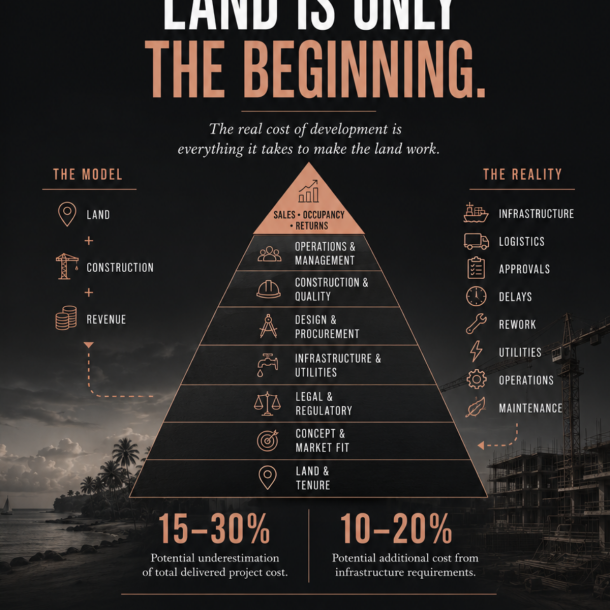
Zanzibar’s investment story is increasingly compelling, but ambitious developments are ultimately determined by what happens between acquiring land and opening the doors. Utilities, infrastructure, logistics, approvals, construction capacity, sequencing, financing and operational readiness can fundamentally alter project economics.
The final brief therefore examines the costs developers often underestimate—and why, in Zanzibar, the price of the land may be one of the easiest costs to understand.
For Zanzibar, the opportunity in business tourism is not to build a conference industry separate from tourism. It is to make the destination itself the competitive advantage.
Series navigation: Previous Brief | View the Series | Next Brief