
September 10, 2026
Market Intelligence

The Zanzibar Market Intelligence Series
Published by Inner-Works Consultants
Market INTELLIGENCE Brief NO. 4
Property investment is commonly discussed in terms of location, price, rental yield and capital appreciation. In Zanzibar’s evolving real-estate market, however, another factor is becoming increasingly important: confidence.
As international buyers enter a market with which they may have limited legal, regulatory and commercial familiarity, the credibility of the developer, clarity of ownership, visibility of construction progress, quality of management and reliability of the investment structure can materially influence purchasing decisions. This brief argues that Zanzibar’s maturing property market is therefore developing what may be described as a Trust Premium: the additional value created when investors believe that what has been promised can actually be delivered.
Trust, in this context, is not a soft concept. It affects buyer confidence, sales absorption, pricing power, referrals, resale prospects and ultimately the long-term value of a development.
A developer may believe they are selling an apartment, villa or residence.
The buyer is often making a much larger decision.
For an international purchaser considering property in Zanzibar, the transaction may involve transferring significant capital into an unfamiliar jurisdiction, purchasing within a legal system they do not fully understand, relying on a developer they may have met only recently and making assumptions about a property that may not yet have been completed.
The property is therefore only one part of what is being purchased.
The other is confidence.
Can the developer deliver what has been promised? Is the underlying land interest secure? What exactly does the purchaser acquire? Can the interest later be transferred or resold? Who will manage the property? Are projected rental returns realistic? Will the surrounding infrastructure and amenities actually be completed? And if something goes wrong, is there a sufficiently clear legal and governance structure to address it?
These questions become particularly important as Zanzibar’s property market evolves from relatively straightforward land and hospitality transactions towards more sophisticated products involving condominiums, managed residences, rental pools and mixed-use communities.
This is one of the most important consequences of the market evolution examined in the previous briefs.
As the product becomes more sophisticated, the buyer’s need for certainty increases with it.
A beachfront site may initially attract attention. Architectural renders may create interest. Projected returns may encourage further enquiry. But none of these necessarily converts interest into investment.
Conversion requires confidence.
The market assessment undertaken for this series reinforces this distinction. Buyer considerations extended beyond headline price and anticipated return to include developer reputation, delivery history, construction progress, legal structure, property management, rental arrangements, surrounding amenities and the credibility of the wider development proposition.
Taken together, these factors reveal something important about the direction in which Zanzibar’s market is moving.
The strongest projects are increasingly competing not only for buyers’ capital.
They are competing for their trust.
In mature property markets, much of the infrastructure of trust is almost invisible.
Buyers operate within established systems of title registration, mortgage finance, valuation, professional property management, transaction databases, consumer protection and relatively transparent comparable pricing. They may still undertake extensive due diligence, but much of the institutional framework surrounding the transaction is already familiar.
Emerging property markets operate differently.
Information may be less centralised. Comparable transaction data may be difficult to obtain. Development models may be relatively new. International purchasers may have limited understanding of local land law, regulatory institutions or ownership structures. In such circumstances, uncertainty becomes part of the investment equation.
And uncertainty has a price.
Consider two otherwise comparable developments.
Both occupy attractive locations. Both offer similar unit sizes. Both promise comparable amenities and projected rental performance.
The first is being delivered by a developer with visible completed projects, functioning infrastructure, occupied properties, established management systems and clearly documented ownership arrangements.
The second exists primarily through renders, sales material and projections.
On paper, their products may appear comparable.
To the buyer, they are not.
The first development has reduced the number of assumptions the investor is required to make. The second requires the purchaser to accept considerably more execution risk.
That difference is the Trust Premium.
The Trust Premium can be understood as the economic value created when a project reduces uncertainty for the buyer.
It is built through several mutually reinforcing factors:
Developer credibility → Legal certainty → Visible execution → Operational capability → Governance → Buyer confidence → Stronger market performance
Each component matters because each answers a different investor concern.
Developer credibility answers: Can these people deliver?
Legal certainty answers: What exactly am I buying?
Visible execution answers: Is the promise becoming reality?
Operational capability answers: What happens after completion?
Governance answers: How will this asset and community function over time?
Together, they answer the most important question:
Can I trust this investment?
This framework also explains why completed projects can have significance beyond the revenue generated from those individual developments. Successful delivery creates a track record. A track record reduces perceived risk. Reduced risk makes subsequent projects easier to market and can strengthen the developer’s ability to attract buyers, partners and capital.
Reputation therefore becomes cumulative.
A developer is not simply completing one project. They are creating—or eroding—the credibility upon which future projects may depend.
This is particularly important in a relatively small investment destination such as Zanzibar, where market participants interact frequently and information travels quickly between developers, investors, advisers, brokers and buyers. Experiences with one project can influence perceptions of another. Positive delivery strengthens confidence in the wider market; poor execution can have effects extending well beyond the individual development concerned.
The Trust Premium is therefore not merely a developer issue.
It is a market maturity issue.
One of the most significant mistakes in real-estate development is to treat legal structuring as something that happens behind the commercial product.
In reality, particularly for international investors, the legal structure is part of the commercial product.
A beautifully designed residence becomes considerably less attractive if the purchaser cannot clearly understand the nature of the interest being acquired, how that interest is registered, what rights accompany it, how common areas are governed, how management obligations operate or how the property can later be transferred.
This becomes especially important as Zanzibar’s market moves towards condominium and mixed-use models.
A standalone property transaction can already involve questions of land tenure, registration, approvals and transfer. An integrated development introduces additional layers: common property, service charges, shared amenities, property management, rental programmes, owner obligations and the long-term governance of the development.
These issues cannot simply be resolved after sales begin.
They should influence project design from the outset.
This is where the distinction between physical architecture and legal architecture becomes useful.
Physical architecture determines how the development looks and functions spatially.
Legal architecture determines how ownership, rights, responsibilities and economic relationships function over time.
A strong project requires both.
For foreign buyers in particular, legal clarity can materially reduce perceived risk. Clear documentation, understandable transaction structures and consistency between what is marketed and what is legally delivered allow purchasers to evaluate an investment on its merits rather than discounting it because of uncertainty.
This has an important commercial implication.
Legal certainty should not be viewed merely as a regulatory cost.
Done properly, it is a sales asset.
The same applies to governance.
Mixed-use communities do not cease to require management when the final unit is sold. Shared infrastructure must be maintained. Common areas require funding. Service standards need to be preserved. Rental programmes must operate transparently. Owners require mechanisms through which common interests can be managed.
Poor governance can therefore diminish the value of an otherwise successful physical development.
Good governance protects it.
There is another dimension of trust that legal documentation alone cannot provide: visible execution.
Property development is fundamentally a promise about the future.
The developer asks today’s buyer to believe in tomorrow’s destination.
The greater the distance between the current reality and that promised future, the more trust the purchaser must provide.
This is why construction progress matters.
It is why functioning infrastructure matters.
It is why occupied phases matter.
It is why existing restaurants, landscaped public spaces, maintained amenities and visible communities can sometimes sell a future phase more effectively than a marketing campaign.
They convert promise into proof.
This becomes especially powerful within phased mixed-use developments. The first phase is not merely the first portion of inventory. It becomes evidence for everything that follows.
If infrastructure works, buyers notice.
If public spaces are maintained, buyers notice.
If rental management functions, buyers notice.
If residents are actually living within the development, buyers notice.
And equally, if promised amenities remain incomplete or service quality deteriorates, the market notices that too.
This reinforces one of the central arguments running through this series: execution is becoming a competitive advantage.
As Zanzibar attracts increasingly sophisticated buyers, projects will be judged not simply by what they promise but by the evidence supporting those promises.
This changes the role of marketing.
Marketing can generate attention.
Trust converts attention into investment.
And delivery converts investment into reputation.
That cycle is what allows successful developers to move from selling individual properties to building enduring brands.
The implications reach beyond the developer. A market populated by credible, well-governed and successfully delivered projects becomes easier for the next investor to understand. Confidence compounds. Institutional investors become more comfortable. International advisers become more willing to recommend the market. Lenders gain better evidence on which to assess risk.
In that sense, every successful development contributes something intangible but extremely valuable to Zanzibar’s wider investment economy:
precedent.
And precedent is one of the foundations upon which mature investment markets are built.
This brief began with a simple proposition: property investors do not purchase physical assets alone. They also purchase confidence in the systems, people and promises surrounding those assets.
As Zanzibar’s real-estate market becomes more sophisticated, that confidence is acquiring increasing economic significance. Location, design and projected returns remain important, but they operate alongside developer credibility, legal certainty, visible execution, governance and operational capability.
Together, these factors create what this brief describes as the Trust Premium: the value generated when uncertainty is reduced and investors can make decisions with greater confidence.
For developers, this means trust must be built into the project rather than added to its marketing. For advisers and regulators, it reinforces the importance of transparent and workable investment structures. And for the market as a whole, every successfully delivered project strengthens the precedent upon which future investment can build.
In an emerging market, trust is not simply a matter of reputation.
It is part of the investment infrastructure.
International property buyers increasingly evaluate certainty alongside price, location and projected returns.
The Trust Premium is created through developer credibility, legal certainty, visible execution, operational capability and effective governance.
Legal architecture should be treated as part of the investment product rather than merely a compliance requirement.
Completed projects and functioning communities provide evidence that reduces perceived investment risk.
Strong delivery creates precedent, and precedent strengthens confidence in the wider Zanzibar property market.
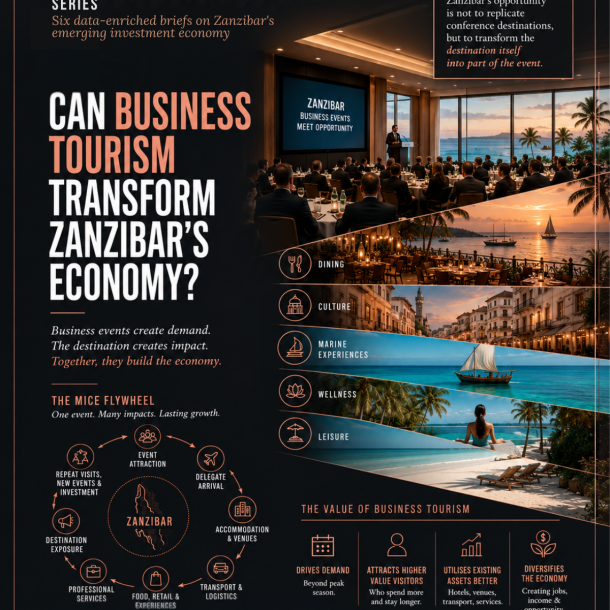
Market Intelligence Brief No. 5 moves from property investment to one of Zanzibar’s most significant opportunities for tourism diversification: business tourism and MICE. As Zanzibar seeks to increase visitor value, reduce seasonality and broaden tourism’s economic impact, meetings, incentives, conferences and exhibitions present an opportunity to attract a fundamentally different type of visitor—one whose expenditure can extend across hotels, transport, restaurants, events, retail and professional services.
The question is no longer simply whether Zanzibar can host conferences.
It is whether business tourism can become another engine of its investment economy.
In emerging markets, the strongest investment proposition is not always the one promising the highest return. Often, it is the one requiring the fewest leaps of faith
Series navigation: Previous Brief | View the Series | Next Brief